Concentric Pipe Reducer
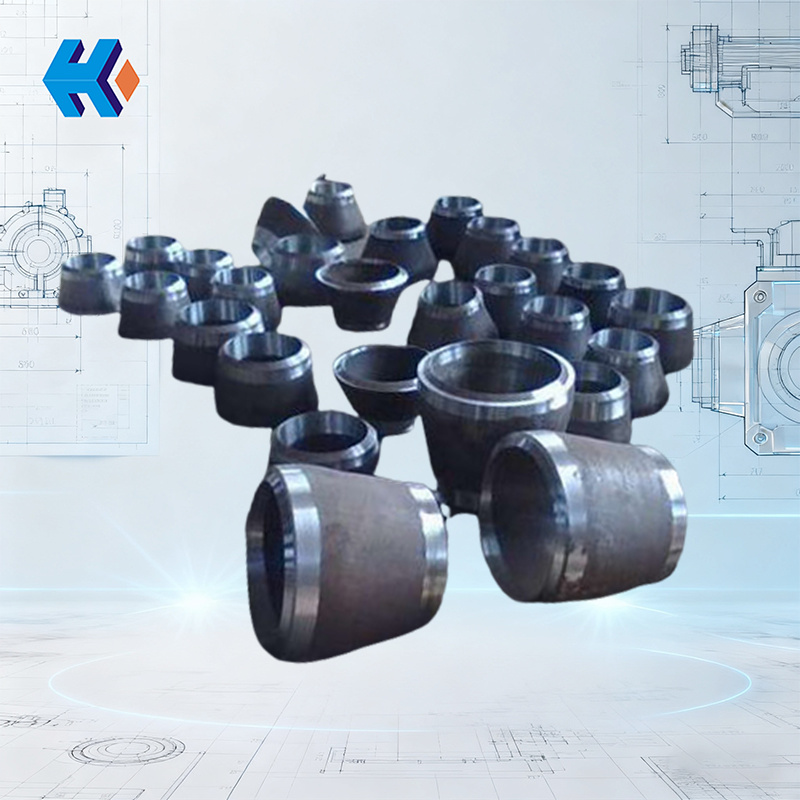

A concentric reducer is a key pipe fitting used in piping systems to connect pipes of different diameters. Its core feature is that the center points of the two ends are on the same straight line, and when placed upright, the projections of the two ends are concentric circles. This design ensures that the fluid maintains axial symmetry during the change in diameter, avoiding flow interference caused by eccentricity.
Quality Standards of Concentric Reducers
The quality must meet the following core requirements:
1. Geometric Accuracy:
- Roundness: The roundness error of the two ports should be ≤1% of the corresponding end's outer diameter, with an allowable deviation of ±3 mm (e.g., for a DN200 end, the roundness should be ≤2 mm, and the total deviation should be within 17-23 mm).
- Concentricity: The centerlines of the two ends must coincide, with an allowable eccentricity deviation of ±5 mm (to prevent flange misalignment during installation).
2. Appearance and Wall Thickness:
- Surface Quality: The surface should be free of cracks, peeling, dents, and other defects. The end faces should be cut flat (perpendicularity deviation ≤1 mm/m).
- Wall Thickness Requirements: The wall thickness at any part should not be less than the wall thickness of the pipe connected to the large-diameter end (e.g., if the wall thickness of the pipe corresponding to the large-diameter end is 8 mm, the minimum wall thickness of the reducer must be ≥8 mm).
3. Dimensional Deviation:
It must comply with the standard's allowable deviations for nominal diameter, wall thickness, and length (e.g., for a DN100×DN50 reducer, the length's allowable deviation is ±5 mm).
With its structural and process advantages, concentric reducers are widely used in piping systems:
- Low Fluid Resistance: The concentric structure ensures smooth flow of media (liquids, gases, steam, etc.), with fewer vortices and a pressure loss that is 10-20% lower than eccentric reducers. It is suitable for connecting pumps, valves, and other equipment at their inlets and outlets.
- Convenient Installation: The concentric design ensures that the flange faces at both ends are parallel and the bolt holes are precisely aligned, reducing installation and adjustment time.
- Strong Adaptability: Reducers can be made of corresponding materials (carbon steel, stainless steel, alloy steel, etc.) according to the pipe material (e.g., a 304 stainless steel reducer is used for corrosion-resistant pipelines), offering high compatibility.
Concentric reducers are key fittings for connecting pipes of different diameters through die pressing. Their quality is strictly controlled by processes and standards, and they play an important role in "smooth transition and reduced resistance" in fluid delivery systems. The application of new processes has further improved the performance and economy of reducers (especially eccentric ones).