Hot-Press Elbow
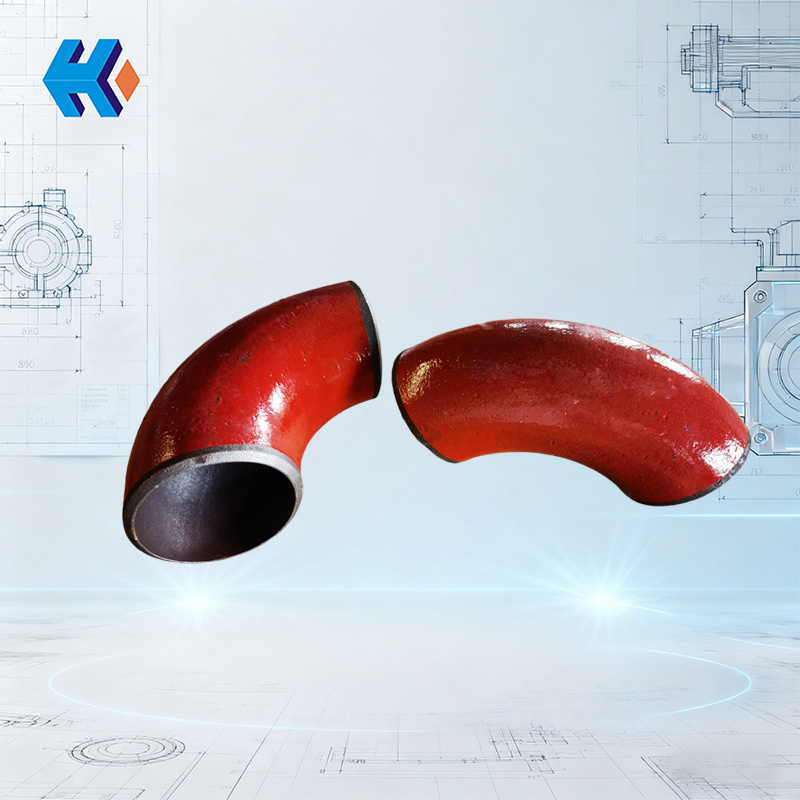

A hot-press elbow is a common pipe fitting used in piping systems, mainly to connect two pipes in different directions to achieve a turn or change in direction. It is widely used in industrial fields such as petroleum, chemical, power, metallurgy, and construction. Its manufacturing process is centered on "hot-pressing," giving it the ability to withstand high-pressure and high-temperature environments.
1. Manufacturing Process and Advantages:
The production of hot-press elbows is mainly based on hot-pressing forming technology. The specific process is roughly as follows:
- Material Preparation: Seamless steel pipes are typically used as blanks and are cut into corresponding lengths based on the elbow's specifications (e.g., diameter, wall thickness, bending radius).
- Heating: The pipe section is heated to a high temperature (generally close to the forging temperature of the steel, e.g., about 1000-1200°C for carbon steel) to make the steel plastic for subsequent shaping.
- Die Pressing: The heated pipe section is placed into a special elbow die and pressed with mechanical pressure (e.g., a hydraulic press) to form the required angle (e.g., 90°, 45°, etc.) and bending radius.
- Post-processing: After forming, the elbow undergoes cooling, heat treatment (e.g., annealing to eliminate internal stress), and surface treatment (e.g., rust removal, painting) to ensure its mechanical properties and corrosion resistance.
Compared to cold bending (bending at room temperature), the advantages of the hot-press process are:
- It can produce large-diameter, thick-walled elbows, and the finished product has a more uniform microstructure and more stable mechanical properties.
- It can reduce defects such as cracking and wrinkling during the bending process, making it especially suitable for high-strength and high-hardness steels.
2. Structure and Classification:
- Basic Structure: Consists of a bent main pipe section with interfaces at both ends for connecting to pipes (e.g., welding ends, flange ends). Common angles include 90°, 45°, and 180° (U-shaped elbows).
- Classification by Bending Radius:
- Long-radius elbow: The bending radius R is approximately 1.5 times the nominal diameter (DN). It is the most widely used type and has low fluid resistance.
- Short-radius elbow: The bending radius R is approximately 1 time the nominal diameter (DN). It is suitable for applications with limited space but has higher fluid resistance.
- Classification by Material: Based on the characteristics of the conveyed medium (e.g., temperature, corrosiveness), materials such as carbon steel (e.g., 20# steel), alloy steel (e.g., Cr-Mo steel), and stainless steel (e.g., 304, 316) can be used.
3. Technical Requirements and Standards:
The quality of hot-press elbows must comply with relevant national or industry standards, for example:
- Dimensional Accuracy: Deviations in diameter, wall thickness, bending angle, and bending radius must be within the allowable range to ensure a tight connection with the pipe.
- Mechanical Properties: After heat treatment, it must meet the specified tensile strength, yield strength, impact toughness, and other indicators to withstand system pressure and temperature.
- Appearance and Internal Quality: The surface should be free of cracks, peeling, dents, and other defects. The interior should be free of inclusions, shrinkage cavities, and other flaws that affect strength. Non-destructive testing (such as ultrasonic or radiographic testing) may be required.
4. Application Scenarios:
Due to their good pressure and high-temperature resistance, hot-press elbows are mainly used in:
- High-pressure piping systems (e.g., steam pipelines, oil and gas pipelines), which can withstand high working pressures (usually ≥1.6 MPa).
- High-temperature environments (e.g., connecting pipes for boilers and heat exchangers), where they can withstand temperatures above 400°C (depending on the material).
- Industrial fields with high strength requirements for pipe fittings, such as pipelines for corrosive media in chemical plants.
In short, hot-press elbows achieve high strength and reliability through the hot-pressing process. They are key components for turning pipelines in industrial piping systems, and their performance directly affects the safe operation of the system.